
By Diego Sánchez Cadavid, photographer and creator of The Dana.
The frames between the frames
Most of what I shoot happens on a set with real lights, a real camera, and a crew. But over 25 years of photographing musicians, actors, and campaigns in Miami, I learned that some of the most honest pictures happen in the gaps. Not long ago I was invited to photograph the headlining artist at a concert at the Kaseya Center in Miami. I arrived the way I always do: two camera bodies, a flash, a trigger, cables, and a neck that was already hurting before the show started. Every setup meant checking the flash, the TTL, the sync. It worked, but it was slow and it was heavy, and I kept thinking the same thing: why is there no app that solves all of this?
Almost at the same time, Godox released the A2, a real xenon flash for the iPhone, the same idea Profoto had explored before. The hardware finally existed. The software I wanted did not.
Light first, always
Everything I know about photography starts with light. A xenon burst is a completely different thing from the LED on a phone: it freezes motion, it has the specular snap of a real strobe, and it lets me decide what the background does. With the A2, the light problem on an iPhone was solved.
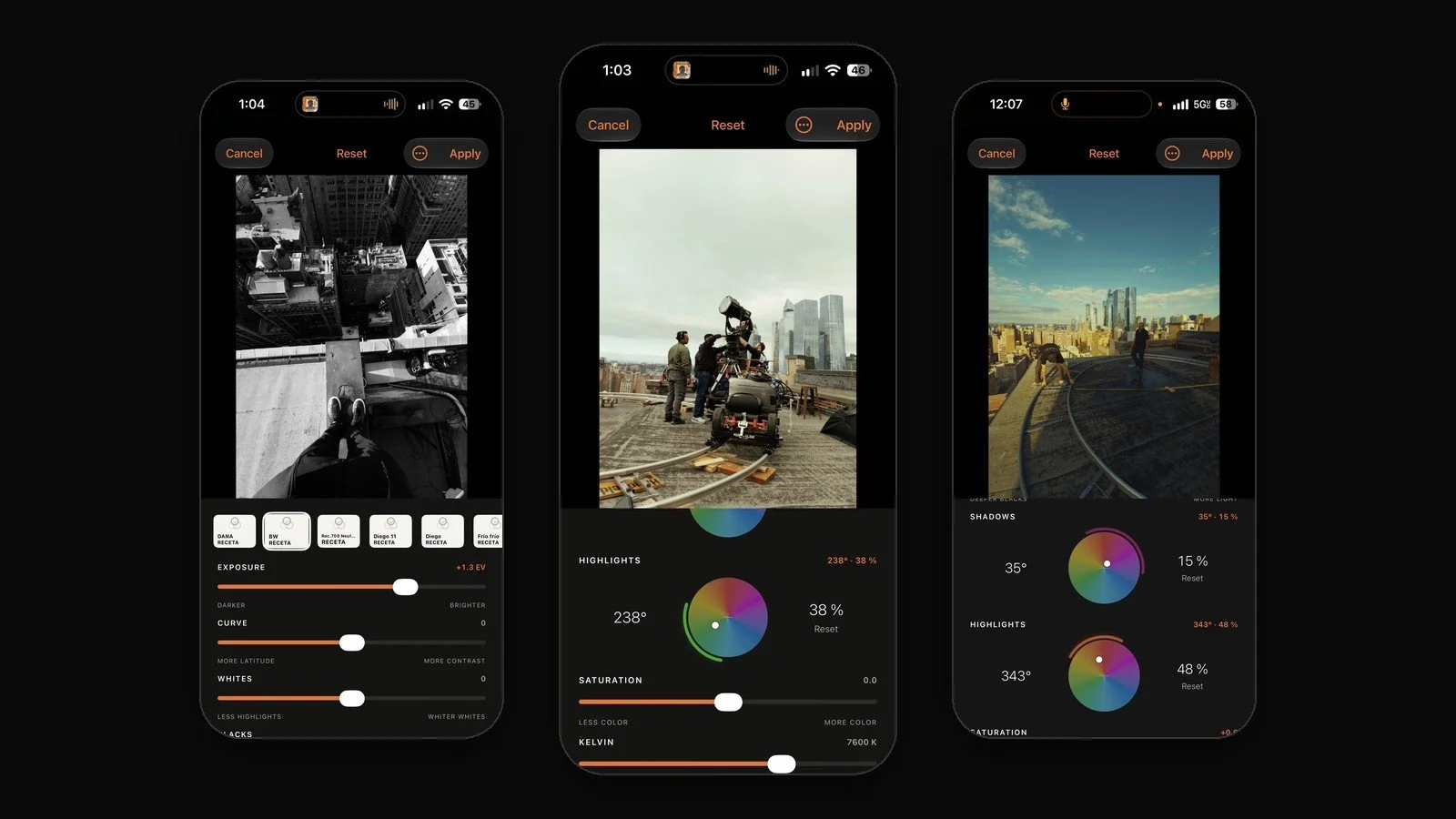
The color problem was not. I wanted on the phone what I use on every single image in a grading session: tint, curves, and separate treatment of shadows and highlights, with the flash metered the way it is in my studio.
So I built The Dana
The Dana is the app I wanted to exist. It has full TTL and manual integration with the Godox A2, and a color engine built on actual color science rather than presets.
I can control tint, curves, contrast, black level, white level, color shift in shadows and highlights independently, and film grain that behaves like emulsion. The film looks inside the app are built from those same controls, so they are starting points, not stickers. And the app captures the full Bayer image from the iPhone sensor, open gate, pure, with no crop, alongside RAW and Apple Log 2.
I developed it with the technology team at ASA Creative, the Miami production company and creative agency behind my commercial work, and it takes its name from Dana Gallery, the fine art gallery where my prints live. The goal was always the same: pictures I would be willing to print.
How I use it on a shoot
The first real test came last weekend, on a music video shoot in New York. I had the Hasselblad and the Fujifilm with me, and in the tight spaces of that set, being in the exact spot at the exact moment with a full camera was often impossible. With the phone and the A2 it was easy. I set my tint before shooting, let TTL handle the first frame, pulled the flash down a touch to let the room breathe, picked one of my own film looks, and kept the grain honest.
The colors were incredible. Everyone on set who saw the frames on the phone asked what it was. Those pictures sit next to the medium format files from the same day without looking like they came from a different photographer. That was the whole point.
One trick I discovered on that shoot: the A2 can act as an optical master. Put your studio flashes on high-speed mode, leave their slave sensors on, and the A2's burst from the phone fires them. I have run full studio heads this way from an iPhone with The Dana handling TTL, and it works beautifully.
What is next
The Godox A2 integration is complete. I am now building integrations with camera triggers and additional flash hardware, so The Dana can become the control surface for small-flash work on iPhone, on set and off.
Links
The Dana is free on the App Store, for iPhone 17 or later with iOS 27.
Read about the app on The Dana's page at ASA Creative.
Read the longer piece on why film-style color grading starts with the light, on ASA Creative.
See everything the app controls in The Dana and the Godox A2, on Dana Gallery.
Browse fine art prints at Dana Gallery.
See the photography that led here across this site.
The Dana is an independent app published by ASA Films. It is not affiliated with or endorsed by Godox or any other flash or radio trigger manufacturer.
