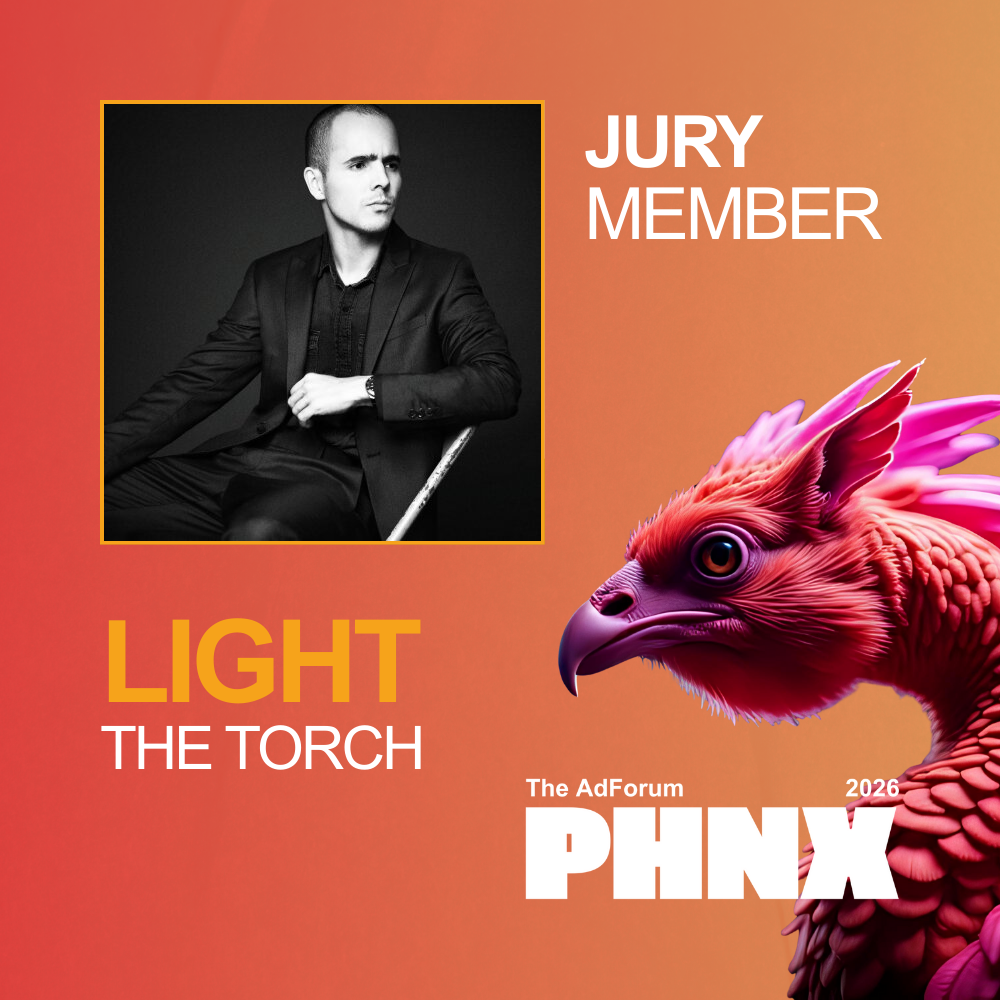
Judging the PHNX Awards 2026: What I Think About Creativity, Speed, and the Future of Advertising
I was invited to serve on the jury for the AdForum PHNX Awards 2026 — an honor that put me in a room (virtually, at least) with some of the sharpest minds in global advertising, asked to judge work across categories and geographies.
The PHNX jury process is unusual because it celebrates debate, not consensus. Jurors are expected to disagree, to defend their positions, and to explain what they value in creative work. That friction is the point. And it forced me to articulate beliefs about advertising that I've held for years but never put into words quite this directly.
Here's what came out.
On Who Holds Creative Authority in 2026
The first question the PHNX organizers asked was about creative power — who holds it today, between platforms, creators, brands, agencies, and AI.
My answer was simple: believe in true art, in human vision and interpretation. But today, that vision falls short if it isn't supported.
In my own practice, I use Machine Learning models to analyze creative work before launch — not so the machine tells me what to create, but to ensure the art creates the maximum possible impact. At ASA Creative, my team analyzed over 14,000 ads, tracking how they multiplied across placements, and built a system that can predict the commercial performance of a creative piece with near-total accuracy.
But there's one variable my system cannot measure: the free will of the audience. That unpredictable human response is exactly where the best advertising lives.
The ones at risk? The purists who think art should be blind to technology. And the technicians who think data can replace soul. Real authority belongs to those who use AI to validate and amplify human emotion — not replace it.
On Why Speed Is Actually Inefficient
This was the point I felt most strongly about. Agencies everywhere are chasing speed and efficiency, and my data proves they're wrong.
After analyzing millions of correlations, we discovered a counter-intuitive truth: the most efficient variable in a campaign is the quality of the artistic interpretation.
Without a strong creative soul, your content instantly becomes noise — just one of billions of daily posts competing for attention. That isn't efficiency; that's waste. Real efficiency comes from standing out immediately.
Speed is useful for iterating. But only art creates the engagement that makes the budget work. If you skip the craft to save time, you're just paying to be ignored.
On the Return to "The Classic"
When asked about the most interesting collaborations happening today, I surprised myself with the answer. I think the obsession with short-form content is destroying quality. We've trained audiences to chase immediacy and quick dopamine hits, and true value is getting lost in the scroll.
The most interesting work I'm seeing is a rebellion against this speed. It's the collaboration between modern brands and timeless craftsmanship. People are tired of the disposable — they're craving the organic and the authentic.
It's like the difference between a disposable gadget and a classic American car: one is built for cheap efficiency, the other is built for soul, elegance, and legacy. The best advertising right now is bringing that solid, classic sensibility back into a digital world.
On How I Spot Ideas That Won't Last
After twenty years working with over thirty agencies worldwide — including BBDO, DDB, McCann, and Mullen Lowe— I've learned to spot the difference between "life" and "immediacy" in creative work.
I instantly distrust an idea when I don't feel the creative's life experience in it. When someone truly pours their experience into an idea, they defend every detail — the craft, the retouching, the color grading, the coherence. But when the goal is just speed, the neglect shows: bad saturation, lazy retouching, prioritizing efficiency over quality.
Trustworthy work needs balance: the modern aesthetic evolution of the younger generation, grounded in the fierce attention to detail of the masters.
On What Matters When You Strip Everything Away
The PHNX question I liked most was this: if entries were stripped of case films, metrics, and storytelling polish, what raw creative quality would still matter?
For me, the answer is simple: visual dominance.
Does the image captivate instantly? Does it pull the viewer into the brand's world without a single word of explanation? As a photographer, I judge based on that immediate power. If an idea needs a manual or a backstory to be understood, it has already failed.
The raw quality I look for is an image that does the entire job in a split second.
On a Time I Was in the Minority
Recently, I worked on a massive campaign for a major client. We had everything: top digital technology, the best cameras, a huge production. But during post-production, the agency and client aligned on an approach I disagreed with — a plastic, non-organic retouching style that literally killed the photograph. It looked like an image from an old encyclopedia.
I fought for the texture. I argued that over-retouching was silently deteriorating the brand's visual identity. But they prioritized efficiency over quality, and I had to let go.
That experience taught me something I now carry into every jury decision: creativity shouldn't be judged by how clean or efficient it is, but by its ability to maintain a brand's soul over time. The "perfect" image might work commercially today, but it's a trap.
Diego Sanchez Cadavid is an advertising photographer and music video director based in Miami. He has photographed campaigns for Coca-Cola, Pepsi, General Motors, Visa, and Toyota. His work has been recognized by Lürzer's Archive, Hasselblad Masters, and the Effie Awards. He is the author of The Lighting Playbook, founder of ASA Creative and The Dana Art Gallery. Full jury interview at AdForum.