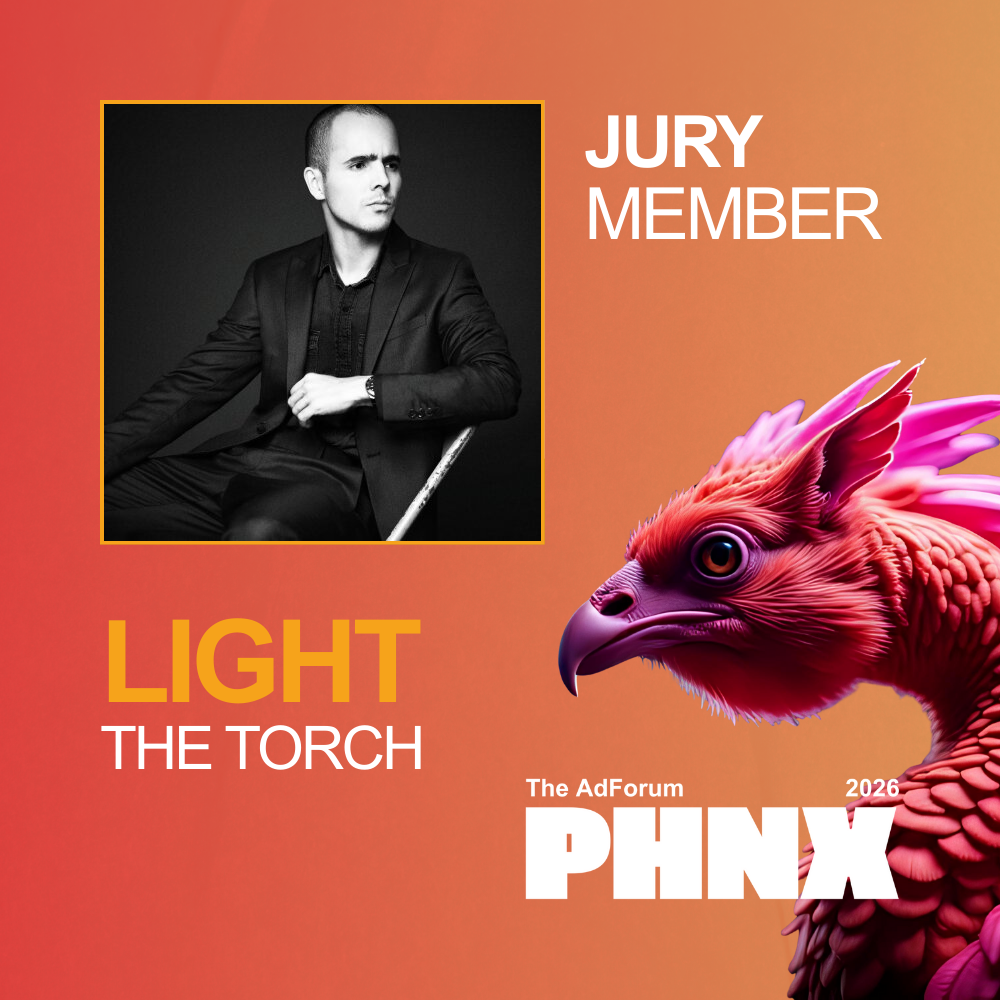
The AdForum PHNX Jury 2026 interview
Creative power is shifting fast. Between platforms, creators, brands, agencies, and now AI, who do you think holds the real creative authority today, and who is at risk of losing it?
Believe in true art—in human vision and interpretation. But today, that vision falls short if it isn't supported.
In my case, authority comes from combining artistic sensibility with data intelligence. I use Machine Learning models to analyze our creative work pre-launch—not so the machine can tell me what to create, but to ensure the art creates the maximum possible impact.
The ones at risk are the purists who think art should be blind to technology, but also the technicians who think data can replace the soul. Real power belongs to those of us who use AI to validate and amplify human emotion, not replace it
As a juror, how do you tell the difference between ideas that last and ideas made mainly to grab attention, please algorithms, or win awards?
At Asafilms, we decided to decode exactly this. We analyzed over 14,000 ads, tracking how they multiplied across placements, and used high-power onsite hardware to correlate the data. We started with Markov chains to find patterns and evolved into a full Machine Learning system.
Today, I can predict the commercial performance of a creative piece—whether it's AI or photography—with almost total accuracy. But there is one variable my system cannot measure: the external social environment, or what I call the 'free will' of the audience.
That is how I tell the difference. Content made for algorithms follows the patterns I can predict mathematically. But ideas that last are the ones that tap into that unmeasurable variable—the cultural and human context that is invisible to the machine, but undeniable to the heart
Many agencies are focusing more on speed and efficiency. What do you think this costs creativity—and what does it improve, if anything?
My data proves that speed without art is actually inefficient.
After analyzing millions of correlations, we discovered a counter-intuitive truth: the most efficient variable in a campaign is the quality of the artistic interpretation.
Why? Because without a strong creative soul, your content instantly becomes noise—just one of billions of daily posts begging for attention. That isn’t efficiency; that is waste. Real efficiency comes from standing out immediately.
So, prioritizing speed costs you relevance. Speed is useful for iterating, but only Art creates the engagement that makes the budget work. If you skip the craft to save time, you are just paying to be ignored.
Which new kinds of collaborations are producing the most interesting work today, and why?
To be honest, I think the obsession with 'Shorts' is destroying quality. We have trained audiences to chase immediacy and quick dopamine hits, and true value is getting lost in the scroll.
That is why the most interesting collaborations today are the ones that rebel against this speed. I’m seeing a return to 'The Classic.'
It is the collaboration between modern brands and timeless craftsmanship. People are tired of the disposable; they are craving the organic and the authentic again. It’s like the difference between a disposable gadget and a classic American car: one is built for cheap efficiency, the other is built for soul, elegance, and legacy. The best work right now is bringing that solid, classic soul back into a digital world."
Audiences are more skeptical, fragmented, and culturally alert than ever. When judging work, what instantly makes you distrust an idea?
After 20 years working with over 30 agencies worldwide, I’ve learned to spot the difference between 'life' and 'immediacy.'
I see two clear patterns today. You have the nostalgic generation that fights for organic storytelling and emotional depth. Then you have the younger generation aesthetically evolved, with incredibly trained eyes but often driven by speed.
I instantly distrust an idea when I don’t feel the creative’s life experience in it. When a creative truly reflects their life in an idea, they defend the craft, the details, and the coherence like a lion. But when the goal is just 'immediacy,' you see the neglect bad saturation, poor retouching because they prioritize efficiency over quality.
To me, trustworthy work needs a balance: the modern aesthetic evolution of the youth, but grounded in the fierce attention to detail of the masters
If PHNX entries were stripped of case films, metrics, and storytelling polish, what raw creative qualities would still matter most to you when awarding an idea?
For me, an image doesn't need a 'concept' or an explanation. It speaks for itself.
If you strip away the case films and the metrics, the only thing that matters is visual dominance. Does the image captivate the viewer instantly? Does it envelop them in the brand's world without a single word?
As a photographer, I judge based on that immediate power. If an idea needs a manual or a backstory to be understood, it has already failed. The raw quality I look for is simple: an image that does the entire job in a split second.
PHNX celebrates debate, not consensus. Can you recall a time when your creative opinion was in the minority, and what that experience taught you about how creativity should (or shouldn’t) be judged
Recently, I worked on a massive campaign for a major client. We had everything: top digital tech, the best cameras, a huge production. But I found myself in the minority during post-production.
The agency and client aligned to create a plastic, non-organic result. The retouching literally killed the picture; it looked like an image from an old encyclopedia. I fought for the texture, but they prioritized efficiency over visual quality, so I had to let go.
That experience taught me that while 'perfect' images might work commercially today, they are a trap. This approach silently and slowly deteriorates a brand's image. Creativity shouldn't be judged by how clean or efficient it is, but by its ability to maintain the brand's soul over time